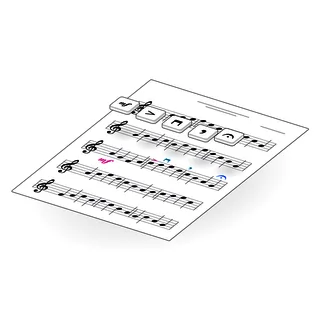
What every marking on your score means.
The articulations, dynamics, bowings and breath marks on your score, what each one asks of you, and how players mark them in.
Articulations.
How each note starts, how long it lasts and how it lets go.
Accent A sideways wedge (>) over or under a note: give that note more emphasis than the notes around it. Marcato A strong accent, written ^ above or below the note: play it marked, with weight and a little space after. Portato A tenuto line with a dot, or dots under a slur: play the notes slightly separated, each with a gentle push. Staccatissimo A small wedge or stroke over the note: play it extremely short, shorter than a staccato. Staccato A dot above or below the note: play it short and detached from the next one. Tenuto A short horizontal line over or under a note: hold it for its full value, often with a gentle weight.
Dynamics.
How loud to play, and how the sound grows and fades.
Crescendo An opening hairpin (<) or cresc.: get gradually louder. Diminuendo A closing hairpin (>) or dim.: get gradually softer. Forte A bold italic f: play loudly. Fortepiano A bold italic fp: start the note loud, then drop straight to soft. Fortissimo A bold italic ff: play very loudly. Mezzo Forte A bold italic mf: moderately loud, a little softer than forte. Mezzo Piano A bold italic mp: moderately soft, a little louder than piano. Pianissimo A bold italic pp: play very softly. Piano A bold italic p: play softly. Sforzando sfz or sf under a note: a sudden, strong accent on that note, then back to the dynamic around it.
Bowings and technique.
Which way the bow travels, and how to draw the sound from your instrument.
Down-Bow A square bracket open at the bottom (⊓) over the note: play it with the bow moving from the frog toward the tip. Harmonic A small circle over a note (or a diamond notehead): touch the string lightly instead of pressing it, for a pure, flute-like tone. Pedal Marking Ped. under the staff means press the sustain pedal; the asterisk (or the end of a bracket) means lift it. Up-Bow A V over the note: play it with the bow moving from the tip toward the frog.
Breaths and pauses.
Where the sound stops, and how long the music waits.
Ornaments.
Quick notes that decorate the written one.
Mordent A short zigzag above the note: play the note, its neighbor, and the note again, quickly. Trill tr above a note, often with a wavy line: alternate quickly between that note and the note above it. Turn A sideways S over or after a note: play the note above, the main note, the note below, and the main note again.
Put your first score on the shelf.
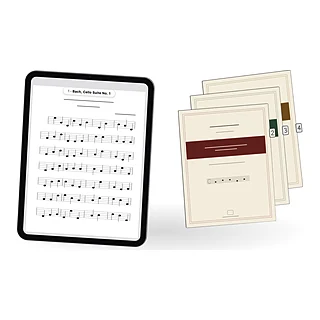
Open a PDF, move your forScore library or scan the score on your stand. You don't need an account to start.
For iPad and iPhone with iPadOS 26 or iOS 26.