
Marcato.
A strong accent, written ^ above or below the note: play it marked, with weight and a little space after.
Also called marcato accent, strong accent, housetop accent, rooftop accent, marcatissimo.
What it means
Marcato is Italian for “marked”. On a single note, it asks for a strong accent: more weight and attack than the music around it, usually with a slight separation after the note. Over a whole passage, the word marcato in the music asks for every note to be played with that same deliberate, emphasized character.
How it’s written
The marcato sign is a narrow wedge, like a little roof: ^. It sits close to the notehead. Above the note it points up; when it’s placed below, it’s turned over and points down, like a v. Most engravers place it above the staff whenever they can.
Players call it a marcato, a strong accent, or a “housetop” or “rooftop” accent.
How it’s played
- Winds and brass: a firm tongue and a strong push of air at the start, then a quick taper. In jazz and big band writing, the housetop accent usually means short and punchy as well as loud.
- Strings: a heavy, biting start to the stroke, often with the bow stopping or lifting a little after. Several marcato notes in a row are often played with separate, strongly weighted strokes.
- Piano: more arm weight into the key than for an ordinary accent, with a clear release.
- Voice: a firm onset on the consonant or vowel, never a glottal shout.
Marcato vs accent
The usual rule: a marcato is stronger than an accent (>), and often shorter. That’s how most teachers and style guides read it. Practice does vary. Some composers used the two almost interchangeably, and in some band and jazz traditions the difference is more about length than loudness. When in doubt, ask your conductor which they mean, and listen to how the rest of the section plays it.
Like every accent, marcato is relative: a marcato in a piano passage is strong for piano, not forte.
Common confusions
- Marcato below the note looks like an up-bow V. The up-bow sign is larger, sits above the staff, and is about the bow’s direction, not the attack.
- The filled wedge is not a marcato. A solid teardrop wedge pointing at the note is a staccatissimo.
Marking it on your score
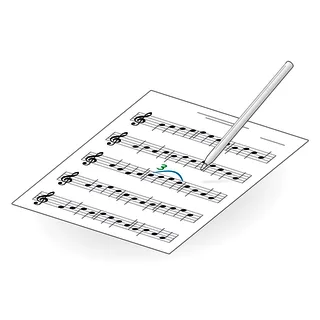
Write a small ^ right above the notehead in pencil, or stamp it: in Marcato, choose the stamp tool, open Articulation and pick Marcato, then tap the note. Move or size it with the lasso.
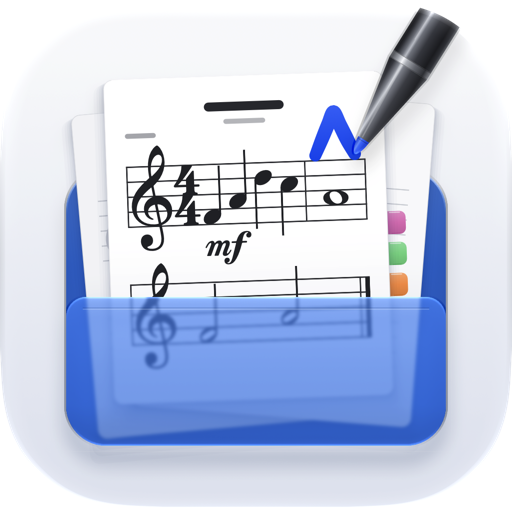
Marcato, the app, is named after this mark.