Turn.
A sideways S over or after a note: play the note above, the main note, the note below, and the main note again.
Also called gruppetto, doppelschlag, inverted turn, grupetto.
What it means
A turn is an ornament that circles the main note: it goes above it, back to it, below it, and back again. It decorates a melody and is especially common in music from the late Baroque through the Romantic era. The Italian name is gruppetto, “little group”.
How it’s written
A sideways S, ∽, above the note or between two notes. Accidentals above or below the sign change the upper or lower note. Without them, the notes follow the key signature.
An inverted turn starts below instead of above. It’s written as the sign flipped, or with a short vertical line through it, depending on the edition.
How it’s played
Where the sign sits changes the rhythm.
| Placement | Played |
|---|---|
| Directly over the note | Upper, main, lower, main, starting on the beat |
| Between two notes (after the first) | Main note first, then upper, main, lower, main, leading into the next note |
| Inverted turn | Lower, main, upper, main |
A turn between notes is the more common one in Classical and Romantic music. You hold the first note for most of its value, then play the four quick notes at the end, landing on the next note in time.
- Speed: the notes of the turn are usually quick, but the tempo and character of the piece decide. In a slow, singing melody a turn can be relaxed and expressive.
- Winds and voice: keep the air or breath flowing through the turn, so it sounds like part of the melody.
- Strings: usually in one bow, with clean, light fingers.
- Piano: an even, relaxed hand. Practice it slowly with the notes written out first.
Common confusions
- Mordent. A mordent is three notes with one neighbor; a turn is four notes with both neighbors.
- Trill with a turn ending. A trill often ends with a written turn, as small grace notes. That’s part of the trill, not a separate sign.
- Where it starts. Over the note, start above it. After the note, play the main note first.
Marking it on your score
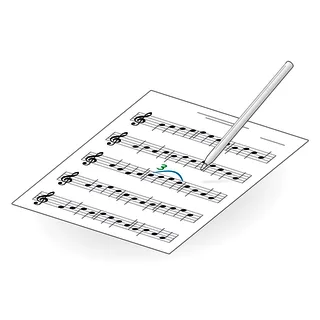
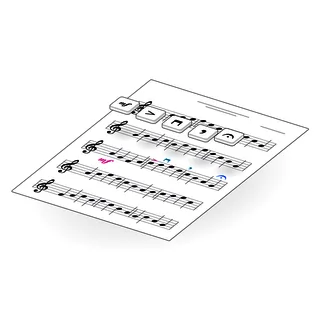
Write the four notes in small above the sign, or a sharp or flat if the key makes the turn’s notes unclear. In Marcato, Turn is in the stamp tool’s Ornaments group, next to Trill and both mordents.