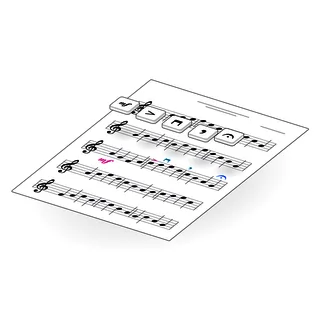
Down-bow.
A square bracket open at the bottom (⊓) over the note: play it with the bow moving from the frog toward the tip.
Also called down bow, downbow, tiré, tirato, down stroke.
What it means
On a bowed string instrument (violin, viola, cello, bass), a down-bow means the bow moves from the frog, the end you hold, toward the tip. On violin and viola, the arm moves away from the body; on cello and bass, the bow pulls across toward your bow-hand side. In French it’s tiré (“pulled”).
How it’s written
A small shape like a square bracket open at the bottom, ⊓, above the note. When the music needs it below, it can go under the note too, but above the staff is the usual place.
The same sign is used for a downstroke with a pick on guitar, mandolin and other plucked instruments.
How it’s played
The down-bow starts with the weight of the arm and the hand close to the string, so it has a natural strength at the start that fades toward the tip. That’s why it’s the usual stroke for:
- Strong beats, especially the first beat of the bar.
- Accented chords, and the start of a loud phrase.
- A diminuendo, since the stroke gets lighter by itself as it travels.
Two down-bows in a row is a retake: lift the bow at the end of the first stroke and set it back near the frog for the second. In printed music it’s often shown with a comma or a breath mark between them.
Bowings in a section
In an orchestra, the principal player decides the bowings, and everyone in the section plays them the same way so the bows move together and the phrasing matches. Most bowings aren’t printed; they’re marked in each player’s score by hand. A good rule is to mark the bowing where it changes from what you’d naturally play, rather than every stroke.
Common confusions
- Down-bow and up-bow. The down-bow is the bracket ⊓; the up-bow is a V.
- The fermata. Both sit over the note, but a fermata is curved with a dot. A down-bow is square.
- “Down” on cello. Cellists and bassists don’t move the bow downward in a vertical sense. The name comes from the violin, where the bow travels down and away from the body.
Marking it on your score
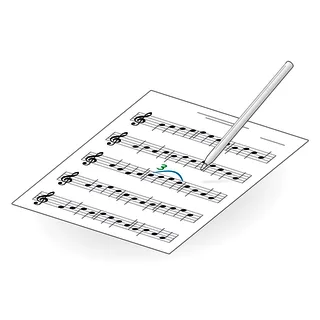
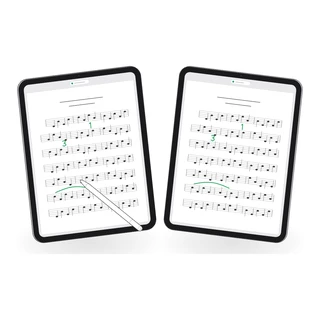
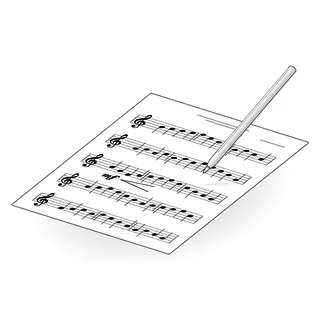
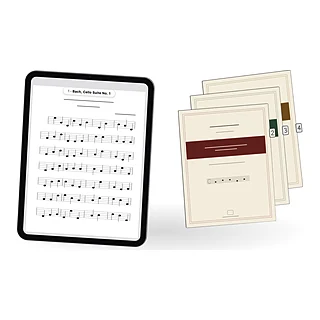
Bowings are the single most common thing string players write in. Mark them small and square, right over the note, so they can’t be mistaken for anything else. In Marcato, Down Bow is in the stamp tool’s Bowing & Breath group, and a down-bow you draw by hand becomes the engraved sign with ink cleanup. Keep the section’s bowings on a layer of their own, apart from your fingerings, so you can show one without the other.