Build a setlist that keeps the room with you.
The order you play in matters almost as much as how you play. Here's how working musicians build a set, time it and read it on a dark stage.
A good setlist is invisible. The audience doesn’t notice the order; they notice that the night felt good. A bad one shows: two slow songs in a row losing the room, a capo change nobody planned, a silence while the bass player looks for the chart.
Start from the gig, not the songs
Before choosing a single tune, answer these:
- How long do you play? Total time, and how many sets.
- When are the breaks? Most bar and wedding gigs run sets of 45 minutes to an hour with 15 minute breaks.
- Who’s listening? A dinner crowd, a dance floor and a concert audience want different arcs.
- What has to happen when? A first dance, a cake cutting, a song the client asked for, a hymn that follows the reading.
- What’s the room? A loud bar won’t hear your quietest ballad.
Write the fixed moments in first. Everything else fits around them.
Put the songs in order
Open strong
Open with something you know cold, in a comfortable key, with a clear start. The first song is when the sound gets fixed and the nerves settle; it shouldn’t be your hardest chart.
Shape the energy
Think of each set as a curve, not a line. A pattern many bands use:
| Place in the set | What it does | Pick |
|---|---|---|
| Opener | Says who you are | Confident, mid to up tempo |
| Songs 2 to 4 | Builds | Familiar, keep momentum |
| Middle | Breathes | A ballad or a feature, then pick it back up |
| Second to last | Peaks | Your strongest crowd song |
| Closer | Leaves them wanting more | Up, memorable, a clear ending |
Avoid two of the same in a row: two ballads, two songs in the same key and tempo, two songs with the same groove.
Group the changes
Every change costs time: a capo, a retune, a switch from guitar to keys, a mute for the trumpets, a singer handing the mic over. Group songs that share a setup, and put the unavoidable changes where a short pause feels natural, like after an applause moment.
Mind the keys
Back-to-back songs a half step apart can sound like a mistake. Keys a fourth or fifth apart move well. If two songs flow straight into each other, check the transition at rehearsal.
Keep extras ready
List two or three songs you can add if the night runs long, and one or two you can cut if it runs short. Put them under a line at the bottom of the set.
Time it
- Write each song’s length from a recording or a rehearsal.
- Add transitions. Count 15 to 30 seconds between songs, more with a change or a story.
- Add it up per set and compare it with the time you have.
- Aim a little short. Gigs start late and requests come in. A set that ends 5 minutes early is easy to fill; one that runs 10 over isn’t.
Write it so you can read it on stage
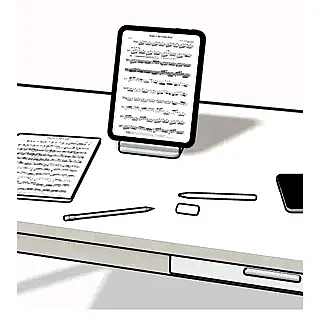
On paper, setlists are written big, in marker, taped to the floor. The same idea works on a screen:
- One line per song, with the title you say out loud, not the file name.
- A short note where it matters: “capo 2”, “attacca”, “count in slow”, “Sarah starts”, “key of G for the singer”.
- The set breaks marked clearly.
- A backup. A printed list, or the list on your phone, in case the stand gets bumped.
Use the setlist to play from
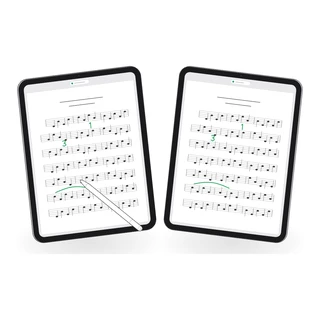
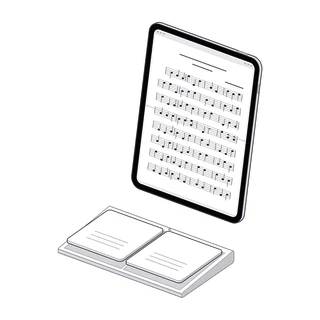
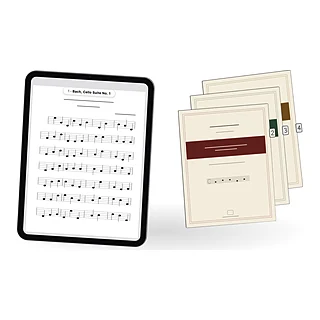
If your charts are on a tablet, the setlist can be more than a list: it can be the order your music opens in. One tap on the first song, and every turn after the last page takes you to the next piece. Pair it with a pedal and your hands never leave your instrument.
Before the gig
- Play the set through once in order at rehearsal, transitions included.
- Check every chart is there and the page order is right.
- Charge everything, including the pedal.
- Send the band the order, so nobody’s guessing.
How Marcato does it
Setlists have their own tab in Marcato. Tap New Setlist and name it (“Smith Wedding”), then Add Scores to pick from your library, or choose Add to Setlist from any score’s menu. Drag lines to reorder. Touch and hold a line for Add Note, for the “capo 2” or “attacca” you need to see on stage.
Tap Play to start from the top, or Play from here on any line. The setlist opens in a tab of its own; each new piece announces its title as you reach it, and a page-turn pedal turns straight from the last page of one piece into the next.
A score can sit in any number of setlists without being copied, so your “Standards” stay in one place. Duplicate last month’s setlist as the start of this one. Forgot a chart? Scan it straight into the setlist from its + menu.
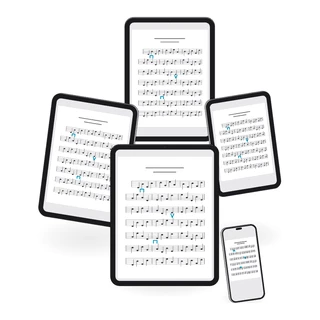
Keep the band’s charts in a group, a folder everyone in the band sees, and a chart you add is in every player’s library. On the night, start a live session and choose Everyone Follows My Page: when you move to the next piece, it opens for everyone who has it, so nobody is a song behind. Your setlists are on your iPhone too, for a backup on the stand.